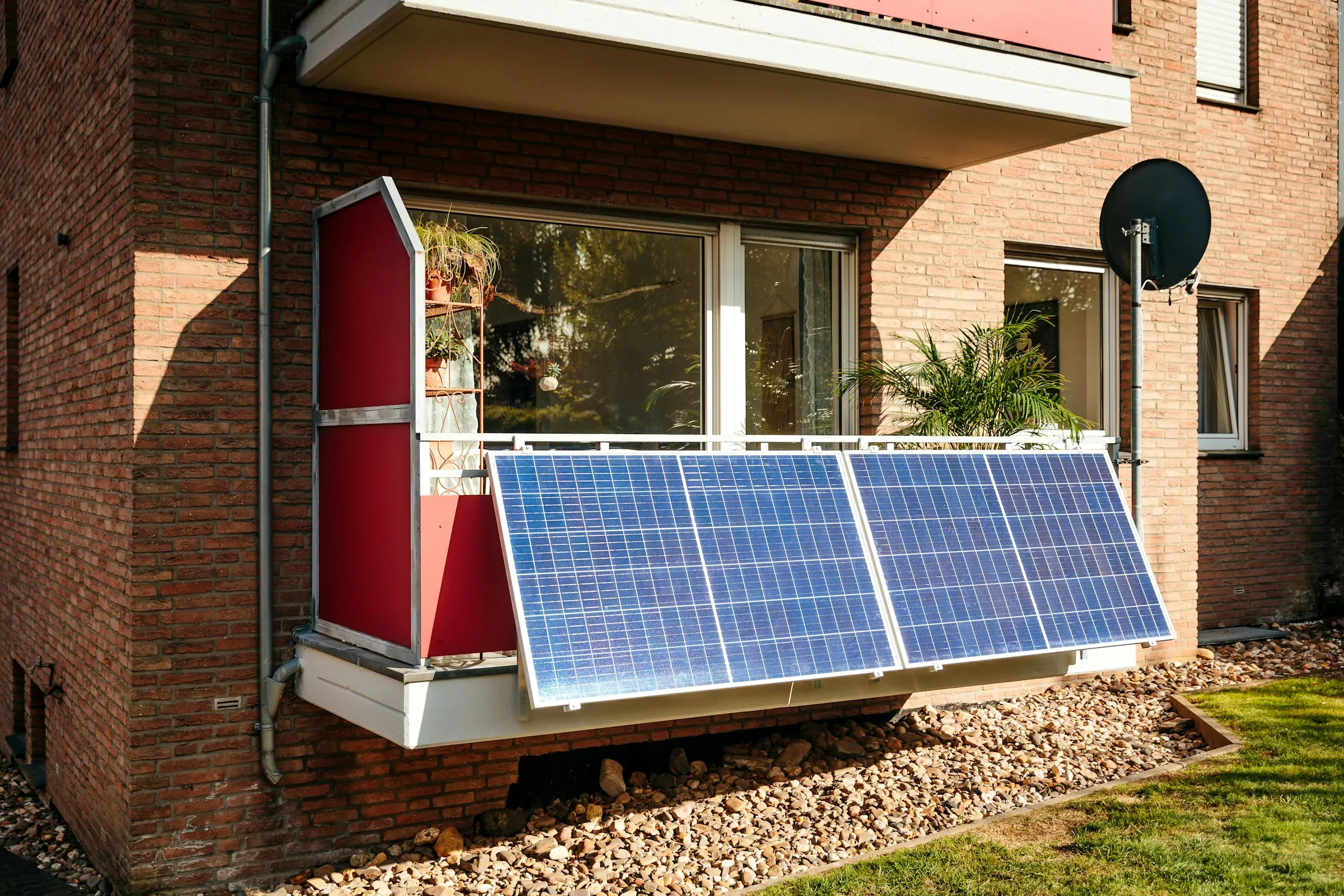

Yes—Shelly Smart Control can help you use more balcony solar electricity at home by scheduling appliances or switching suitable loads when surplus power is available. Shelly documents this kind of automation, but it requires compatible measuring and switching hardware. Installing the app alone does not increase self-consumption. Shelly surplus-control documentation
For U.S. households, there is another important limitation: a German-style plug-in solar setup is not automatically approved for your address. Local installation requirements and your utility’s billing rules also determine whether shifting consumption makes financial sense.
What balcony solar self-consumption means
A Balkonkraftwerk, commonly called balcony solar or plug-in solar in English, is a small photovoltaic system intended to offset household electricity use. For a U.S. example, Utah defines qualifying portable solar devices as systems with maximum output of 1,200 watts that connect through a standard 120-volt outlet, meet electrical-code requirements, and have recognized laboratory certification. Those are Utah-specific conditions, not nationwide permission. Utah Code, Chapter 54-15
Self-consumption is the portion of your solar generation used in your home instead of exported to the grid.
Here is a hypothetical example:
- Your panels produce 500 watts.
- Your home already uses 300 watts.
- That leaves 200 watts available for another load.
- Moving a suitable 100-watt appliance into that period could use some of the surplus.
The app changes when electricity is consumed, not how much sunlight your panels receive. Running an unnecessary appliance simply to absorb solar power does not create a useful saving.
Check the U.S. installation and billing context first
U.S. solar permitting, inspections, and interconnection processes depend on the jurisdiction. A small system’s size does not, by itself, establish that its proposed connection is acceptable. The Department of Energy describes these local requirements in its consumer solar guidance. DOE solar installation guide
For balcony installations, the practical checks include the approved equipment and connection method, plus any applicable landlord or building restrictions.
Then consider export compensation. In California’s PG&E, SCE, and SDG&E Solar Billing Plan, export credits are usually below retail electricity rates, although they can exceed retail rates during some late-summer evenings. That makes the timing of consumption important; maximizing self-consumption is not automatically the most valuable choice at every hour. California Public Utilities Commission
Budget analysis: shifting one kilowatt-hour is worth approximately the electricity purchase you avoid, minus the export credit you give up. If those values are equal, the incremental saving may be negligible.
How Shelly can help
Start with schedules
Shelly’s free app supports energy monitoring with compatible devices, schedules, and scenes. You can move a suitable appliance’s operating window toward your usual sunny hours. This is useful when your routine is predictable, but a fixed schedule cannot know whether clouds have reduced output. Shelly Smart Control U.S. overview
For a financially cautious household, that is a sensible starting point: identify consumption you can move without adding extra runtime.
An appliance’s existing delay-start function is another option. If you already have one, trying it costs nothing extra.
Use measured surplus for more precise control
Shelly’s documented surplus-control example uses a Pro 3EM to measure grid power, then scenes to control loads. It also recommends delays and separate switching thresholds to reduce frequent on/off changes. Its example involves a large, three-phase heating arrangement; it is evidence of the control approach, not a wiring recipe for a U.S. balcony installation. Shelly surplus-control documentation
For your setup, the important distinction is:
- Solar production measurement tells you what the panels generate.
- Appliance measurement tells you what one device consumes.
- Net grid measurement tells you whether the home is importing or exporting.
A smart plug monitoring one appliance cannot establish whole-home surplus by itself.
Recommendation: use appropriately specified metering and installation for your home’s electrical service. Start with one flexible load, conservative settings, and appliance-approved operating behavior. Do not repeatedly interrupt a running appliance cycle just because a cloud passes.
Free Shelly, Premium, or manual timing?
The meaningful comparison here is between Shelly’s free and paid tiers and a manual alternative. A longer list of unrelated energy apps would not resolve the underlying hardware requirement.
U.S. price/function matrix — as of 2026-09-08
The period below is 12 months. Costs are incremental to an existing, approved solar installation.
| Option | Relevant function | Software cost over 12 months | Setup and total-cost limits | Platform and eligibility |
|---|---|---|---|---|
| Manual timing or existing delay-start | Move necessary use into sunny hours | $0 | $0 additional equipment if existing controls suffice | No app required; appliance must support the intended timing |
| Shelly Smart Control Free | Compatible-device monitoring, schedules, and scenes | $0 | Existing compatible hardware: $0 purchase cost. One U.S. Plug Gen4: $24.99, plus shipping/tax. Surplus sensing and installation extra if needed | U.S. iOS listing; Android supported through Google Play; browser interface. Shelly account and compatible hardware required |
| Shelly Smart Control Premium | Adds finer historical charts and weather-based scenes | U.S. dollar price: not publicly documented in the reviewed sources | Same hardware needs as Free, plus subscription. Complete U.S. total: not publicly documented | Same ecosystem; subscription required |
The U.S. Shelly store listed the Plug US Gen4 at $24.99 and in stock when researched. That is an appliance-control accessory, not a complete solar-surplus system. Its U.S. specifications list power measurement and a maximum 15 A/1,800 W load; the appliance’s own requirements still matter. Shelly Plug US Gen4
Shelly’s U.S. Premium page displays €3.99 monthly or €35.99 annually, rather than a verified U.S. dollar checkout price. It advertises a three-month trial for customers who have not previously tried Premium. Those euro figures are not treated here as U.S. subscription prices. Shelly Premium plans
The app is listed in the U.S. Apple App Store, with iOS/iPadOS 15 or later required. Android distribution is documented through Google Play and Shelly’s U.S. materials; availability for an individual Android device remains subject to its store compatibility check.
Shelly Free: the strongest starting point
Pros: no subscription fee; relevant monitoring and automation tools; useful for households already using compatible Shelly equipment.
Cons: hardware costs can exceed a small system’s additional savings. A schedule alone cannot respond to actual surplus.
Best suited to: one or two flexible loads and households that already have the necessary equipment.
Unsuitable when: you expect the phone alone to measure generation, detect exports, or control an unsupported appliance.
Shelly Premium: useful detail, uncertain financial return
Shelly’s published comparison gives Free historical visualization in one-hour intervals and Premium in one-minute intervals. Premium also adds weather-forecast scene execution. These are documented features; finer charts are not evidence of greater electricity savings. Shelly Premium feature comparison
Pros: more detailed historical information and weather-based automation.
Cons: recurring cost; weather forecasts do not measure actual surplus; the reviewed U.S. page does not establish a dollar subscription price.
Best suited to: people who value the additional information or already have a specific use for weather-based scenes.
Unsuitable when: the sole justification is an assumed increase in solar savings. The documentation does not establish that Premium pays for itself.
Manual timing: the useful benchmark
Pros: potentially no additional cost and little setup.
Cons: requires attention or predictable routines; cannot automatically follow changing exports.
Best suited to: someone at home during sunny hours or using an existing delay-start feature.
Unsuitable when: loads need frequent adjustments that your schedule cannot accommodate.
A hypothetical 12-month savings example
This is an illustrative calculation, not a forecast or observed result.
Assume a U.S. household already has an approved balcony solar installation and:
- Moves 200 kWh per year from grid-powered operation to otherwise-exported solar.
- Avoids an assumed $0.20/kWh electricity purchase.
- Gives up an assumed $0.05/kWh export credit.
- Uses Shelly Free and buys one plug at the sourced $24.99 U.S. price.
The electricity rates are disclosed assumptions, not a quoted utility tariff. The hardware price comes from Shelly’s U.S. store.
Annual gross benefit:
200 kWh × ($0.20 − $0.05) = $30
First-year benefit after the plug purchase:
$30 − $24.99 = $5.01
That $5.01 is before shipping, sales tax, control-device electricity use, and any additional metering or installation. Full first-year net savings equal $5.01 minus those costs. This example therefore cannot justify a new whole-home monitoring installation by itself.
Ignoring those additional costs, the plug’s purchase-price break-even is:
$24.99 ÷ $0.15/kWh = 166.6 kWh shifted
At the assumed 200 kWh annually, that is about 10 months. Actual payback would be longer once additional costs are included.
If manual timing shifts the same 200 kWh with existing controls, its annual benefit is $30 with no new equipment purchase. Automation only improves the financial result if it captures enough additional savings to cover its costs.
For Premium, subtract the actual 12-month subscription charge as well. With a $0.15/kWh benefit, each $1 of subscription cost requires another 6.67 kWh shifted merely to break even.
Cloud access and privacy
Shelly says the app supports local-network control as well as cloud operation, with some devices requiring cloud access for full functionality. Local control should not be interpreted as a guarantee that every automation feature works offline. Shelly connectivity guidance
The U.S. Apple listing’s developer-supplied privacy disclosure includes contact information, user content, usage data, and diagnostics potentially linked to identity. Apple notes that it has not verified the disclosure. This is a published privacy statement, not an independent privacy audit. U.S. App Store privacy disclosure
Comparison method
This researched comparison was prepared on September 8, 2026, for U.S. households. Criteria were surplus-control functionality, incremental 12-month cost, platform availability, hardware requirements, regional limitations, and privacy disclosures.
Sources prioritize Shelly documentation, official store listings, U.S. government guidance, and utility-regulatory information. No hands-on testing was performed. Unrelated budgeting apps, battery-system comparisons, and European equipment prices were excluded because they do not directly answer whether Shelly improves U.S. balcony solar self-consumption.
Conclusion
Shelly can increase balcony solar self-consumption when suitable appliances run during genuine surplus periods. For a small U.S. installation, the free app or manual timing is often the most defensible starting point. The financial benefit depends on export credits, usable surplus, and total hardware costs—not simply on having more automation.
References
- Shelly: surplus measurement and automation
- Shelly U.S.: Smart Control and Premium comparison
- Shelly U.S.: Plug Gen4 specifications and price
- Apple U.S.: Shelly app listing and Google Play listing
- Utah Code: solar definitions and requirements
- DOE: consumer solar installation guidance
- CPUC: net metering and net billing